




 Cinema Portal
 Election Portal
 Share Dhani Portal
 Unicode Page
 English Edition
 Share Training
 PREMIUM
 सुन-चाँदीको भाउ
 विदेशी विनिमयदर
 मिति रुपान्तरण
 पेट्रोलको भाउ
 तरकारी/फलफूल भाउ
 आर्थिक राशिफल
 आजको मौसम
 AQI Page



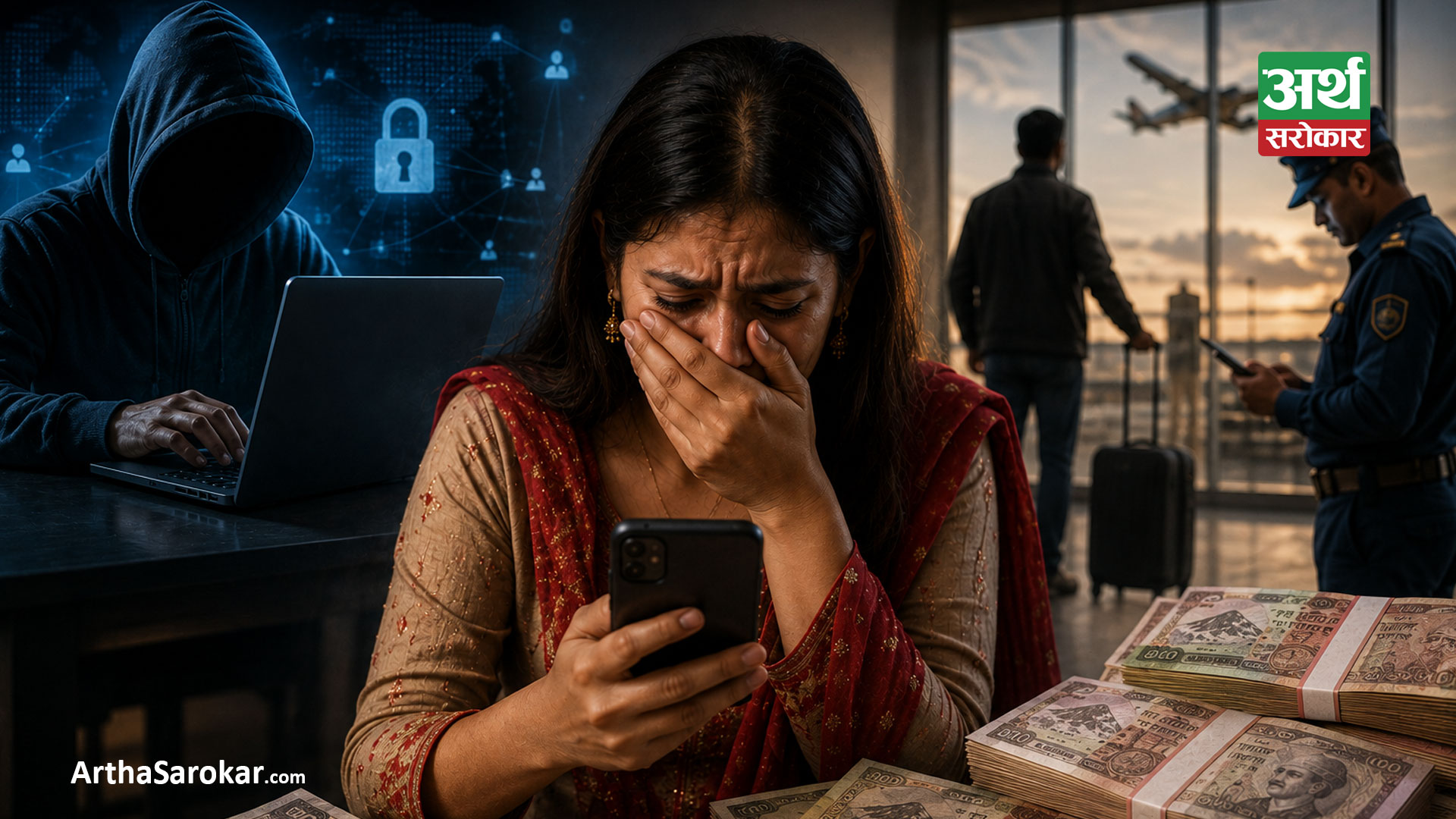
Kathmandu. With the development of technology, new and complex forms of online fraud (cybercrime) have started coming to the surface in recent times. A horrific example of such fraud through social media has been seen recently in Kaski, where a woman lost Rs 31 lakh due to the temptation of a stranger.
According to the District Police Office, Kaski, the story of the woman’s cheating started on Facebook. A man who used a WhatsApp number with a UK code had befriended him saying that he was unmarried and had a lot of wealth in the UK. During the conversation, the man had promised that he was going to sell all the property in the UK and come to Nepal and buy a house in Nepal and live with him.
The man used to send airport videos and make video calls to convince the woman. After some time, he said that he was coming to Nepal via India. Soon after, she received a call from a WhatsApp number with a profile picture (DP) of an Indian police uniform. “Your friend has been caught with a huge amount of cash and property, you have to pay customs and fines to get him released,” the phone said. ’
Thinking that her future husband was in trouble, the woman initially sent Rs 9 lakh. After sending so much money, she went to the District Police Office, Kaski, suspecting that she had been cheated. The police investigated and warned him not to send a single rupee more. But the psychological impact of the fraud was so strong that despite the police’s warning, the woman sent Rs 22 lakh again.
According to the police, the man had emotionally blackmailed him by saying, ‘I am leaving now, after paying the remaining 22 lakhs, I will come to you with all the property’. It was only after she lost Rs 31 lakh and was convinced that the man was a criminal in coordination with the Indian police that the woman came to terms with the fact that she had been duped.
According to Birendra Paswan, information officer at the District Police Office, Kaski, the incident is just a representative example. There are many types of fraud active in the market today. On Facebook and Tiktok, advertisements of cheap goods are placed, people are asked to share the screen saying ‘money did not come’ after ordering, and money is being withdrawn from the bank account through the OTP received on the mobile. Facebook and WhatsApp of close friends or relatives have been hacked and sent messages saying ‘I am in trouble, send money immediately’.
The gang of making fake documents and swindling large sums of money in the name of processing is equally active. The trend of asking for OTP and transferring money from the account on the pretext of updating KYC by becoming employees of banks or e-sewa and Khalti has also increased. There are also active ‘online betting’ and fake investment schemes that win trust by giving a small amount back in the beginning and then become incommunicado with millions of rupees.
Information Officer Paswan has urged the public to take special precautions to avoid online fraud. “Don’t be tempted by a stranger on social media. The first sign of fraud is the promise of high profit or cheap goods with little investment. ” he said.
The police have appealed to the general public not to share their bank account details, PIN number and OTP to anyone, open suspicious links, download unauthorised apps and check authenticity before doing any online transaction. Kaski Police has urged the people to immediately contact the nearest police office if they suspect fraud.








प्रतिक्रिया दिनुहोस्