

 Cinema Portal
 Election Portal
 Share Dhani Portal
 Unicode Page
 English Edition
 Share Training
 PREMIUM
 सुन-चाँदीको भाउ
 विदेशी विनिमयदर
 मिति रुपान्तरण
 पेट्रोलको भाउ
 तरकारी/फलफूल भाउ
 आर्थिक राशिफल
 आजको मौसम
 AQI Page


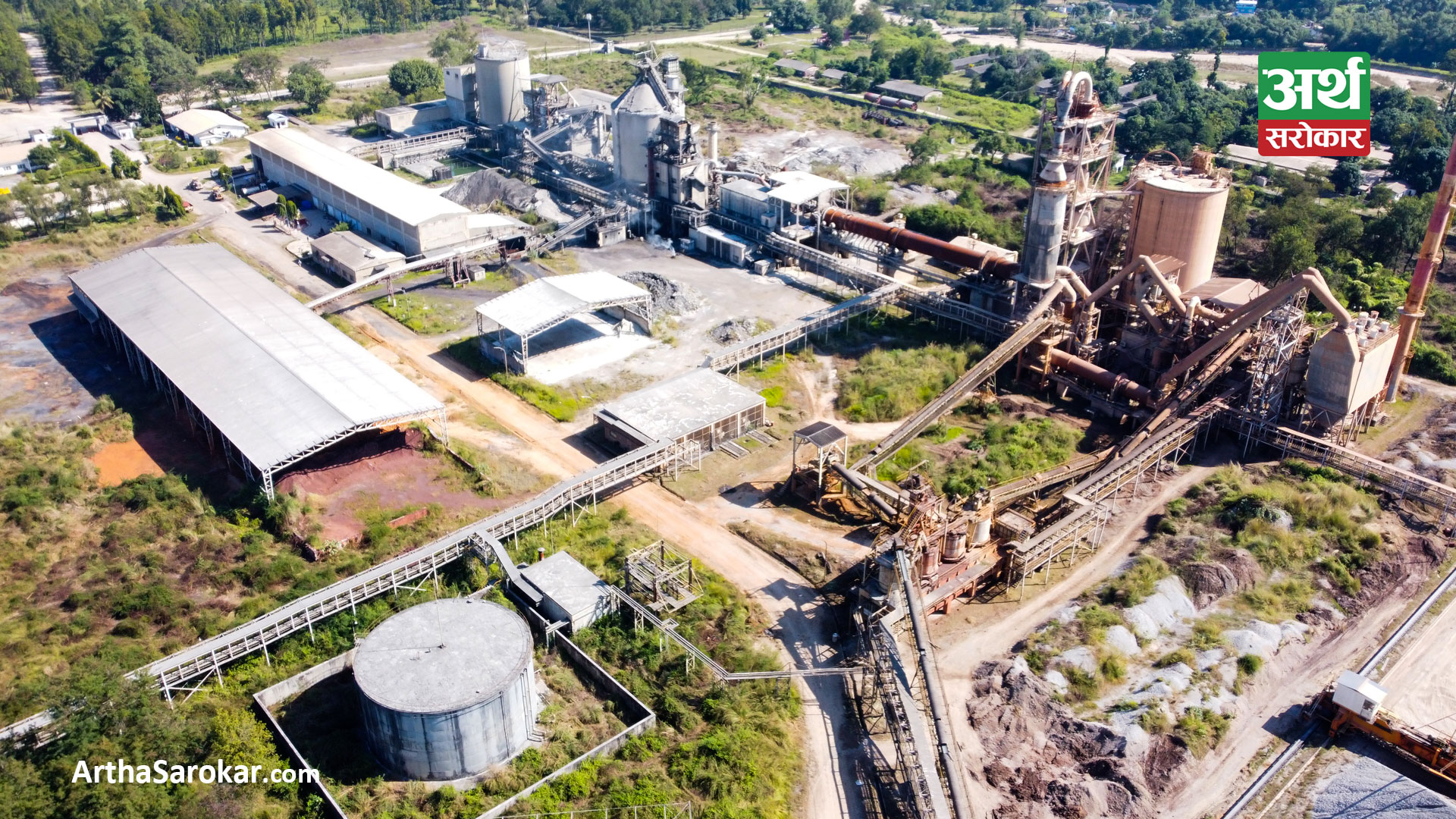
Kathmandu. High-quality limestone quarry, a factory built with Japanese assistance. ‘Rhino Seal’ brand established in the market. Despite all this, the Udayapur cement industry is in crisis.
Corruption, managerial weaknesses, political interference and personal and group interests have contributed significantly to the development of Gaighat Bazaar. The latest example of this is cement that has been lying idle for 6 months due to lack of sacks.
The lack of cement sacks stored in warehouses after production means that poor management and short-sighted thinking of the leadership. It is not difficult to understand the state of the industry as the private companies are producing and selling cement.
According to Serious Jung Khatri, administrative chief of the industry, Chitwan-based Ashirwad Poly Pack had already supplied 527,000 sacks six months ago. However, in March, the company clarified that it would not be able to provide the sacks until the payment was made, citing reasons such as an increase in the price of fuel.
“At that time, the industry owed Rs 2.7 million to the company, we were not in a position to pay the money, so the supply of sacks was stopped. “, he said. More than Rs 900,000 has already been paid after the supply of sacks last time and now around Rs 36 lakh, old and new, are yet to be paid.
Anil Bhandari, a shareholder and market head of Ashirwad Poly PACS, however, has a different argument on the issue of payment. According to him, an agreement was reached with the industry about five years ago to supply 10 lakh sacks in two years. However, around 5.80 lakh sacks have been supplied so far as the industry did not demand it. According to him, the company had recently paid only Rs 500,000 and now around Rs 42 lakh is yet to be paid.
Expensive coal purchase
The industry has been heavily criticized for purchasing coal at a high price. The private sector industries are buying coal at Rs 19,000 to Rs 20,000 per tonne on an average while the industries are buying coal at Rs 25,000 to Rs 30,000 on an average. For example, the industry had purchased coal at Rs 27,666 per tonne on October 28, 2080 and November 16 of the same year, while it had purchased coal at Rs 23,838 per tonne on July 14 of the same year. In this way, the industry is incurring an average loss of Rs 5,000 to Rs 10,000 per tonne on coal. The industry needs 50,000 tonnes of coal annually to run at full capacity. According to the Department of Customs, coal was being imported at Rs 13,000 per tonne when the industry was purchasing coal at a high price. The industry seems to be buying imported coal at almost double the price.
Not only that, the quality of coal was also questioned. Questions have also been raised about the quality of coal required for the industry. The study also found that there was discrepancy in the GCV standard and ‘moisturizing’ standards of coal used in the industry.
Killcell machine glitch
Two years ago, the factory met with an accident while importing 20.8 meters of the 60-meter-long kisel. As a result, more than five crore rupees were incurred. Currently, the three-piece Killsell is in limbo. After being damaged, it has not been repaired and is now in an abandoned condition.
Earlier, about Rs 60 million was spent on the purchase of a 5.8 meter long kisel, but later the accident while buying a 20.8 meter kisel at a lower price is seen as unnatural. This has caused a huge loss to the operation of the industry.
Case in Authority
The Commission for the Investigation of Abuse of Authority (CIAA) is currently investigating six cases related to the industry involved in corruption and poor management. Of them, cases have been filed in two cases and four are under investigation.
In which the general manager of the industry also colluded with the tender no. 44-7 New Ion Suppliers Siddharthanagar, Rupandehi is being investigated for irregularities by giving 10 percent discount on stock, while the then general manager Surendra Poudel also colluded with the then general manager Surendra Poudel to ruin the industry.
According to the CIAA, the then General Manager of Udayapur Cement Industry Limited was awarded the tender no. Investigations are also underway into the fact that the amount was paid in excess of the agreement on 31-1/074/75. The CIAA is also investigating into allegations that the then general manager of the mill had resold the coal purchased in the previous fiscal year as rejected.
Likewise, a case has been filed against the then General Manager alleging that the raw materials, limestone and clinker used in cement production from the fiscal year 2064/65 to mid-Poush 2077 were high and the production was low.
Old technology
Outdated technology and machinery seem to be the main reason for the collapse of the industry. Ropeways, coal mills, control systems and other equipment have not been upgraded as per the time due to the dependence on old technology from mining to operation of factories. The cost of production has also increased due to lack of adoption of modern technology. Similarly, the cost of mining is high. Extraction of limestone from the outdated blasting system has become costly due to explosives, security and army mobilization. Despite having big and quality mines, they have not been able to take advantage of modern extraction technology.
Similarly, low productivity is another problem in the industry. While many of the factory’s equipment is designed for higher production capacity, the actual output is less than that. Although production can be increased through general maintenance and system improvements, not enough work has been done in this direction.
The industry has not been able to gain momentum due to poor management and accountability. Lack of regular monitoring of the industry, change of leadership but lack of implementation of long-term plan and lack of adequate monitoring and reporting on the condition of the industry by the responsible body have become problems.
Sources claim that political interference in the industry and unionism have also affected the management. It is said that production has been affected due to the tendency of not working and internal maneuvering. Similarly, there is the problem of manpower management. It is stated that there is more manpower than required and high staff cost, skilled and experienced technical employees are retiring but the administrative manpower is high. Experts say that the inability to mobilize skilled manpower according to the skills has also affected productivity. At the same time, energy costs have not been adequately controlled. Electricity consumption is high due to old systems and large motors, and not enough attention has been paid to the energy audit and system improvements.
Similarly, the lack of a commercial market strategy has also weakened the industry. Despite the availability of high-quality limestone and clinker, potential markets such as clinker sales, block cement and PPC have not been adequately utilized.
Attempt
The Udaipur cement industry is one of the biggest strengths in the industry. The mine is located in Sukaura (Sindhuwa) in the northern part of the district and is located about 27 km north of Jaljale in Triyuga Municipality-6. According to a study conducted by the Japanese government, the mine has the capacity to produce 73.5 million metric tons of limestone. Of this, only 40 lakh metric tonnes has been excavated so far. Now, that is, a large part is yet to be used.
This mine is important because experts claim that the limestone found in it is the best in Nepal. The average MgO in this limestone is 1.5 percent. The lower the MGO, the better it is for cement. Whereas MGOs used in cement are accepted up to 5 percent.
Kumari Jyoti Joshi, director general of Nepal Bureau of Standards and Metrology, said that the standard of cement in Nepal is 5 percent MgO for OPC (33 grade), OPC 43 and 53 grade and 6 percent MgO for PPC cement.
Most of the cement companies operating in Nepal are struggling to meet this standard. The limestone found in the mines has more than 52 percent calcium oxide. On average, limestone with calcium oxide content of 44-48 percent is found in other mines of Nepal.
As it is of high quality, only 82 per cent limestone is sufficient for cement production. The limestone found in other mines has to be used up to 90 percent. The industry uses 3 per cent silica sand, 13 per cent red clay and 2 per cent iron for cement production. At present, the industry does not have to import raw materials except iron.
The Department of Mines and Geology had revoked the license of the mine in 2081 BS. The department pointed out that the government industries have not paid Rs 74 lakh in revenue. Experts say that various interest groups are behind this. According to an expert studying the industry, attempts have been made time and again to acquire the limestone extracted from the mine. Due to this, there is a problem of frequent closures and lack of timely supply.
However, the license has been renewed by paying the revenue to the department within 100 days of the formation of the present government. This put a stop to the move to give ownership of the mine to other companies. The incumbent government is preparing to run the Udayapur Cement Industry in full capacity by appointing a general manager. The industry has a daily production capacity of 800 metric tons.






प्रतिक्रिया दिनुहोस्