



 Cinema Portal
 Election Portal
 Share Dhani Portal
 Unicode Page
 English Edition
 Share Training
 PREMIUM
 सुन-चाँदीको भाउ
 विदेशी विनिमयदर
 मिति रुपान्तरण
 पेट्रोलको भाउ
 तरकारी/फलफूल भाउ
 आर्थिक राशिफल
 आजको मौसम
 AQI Page



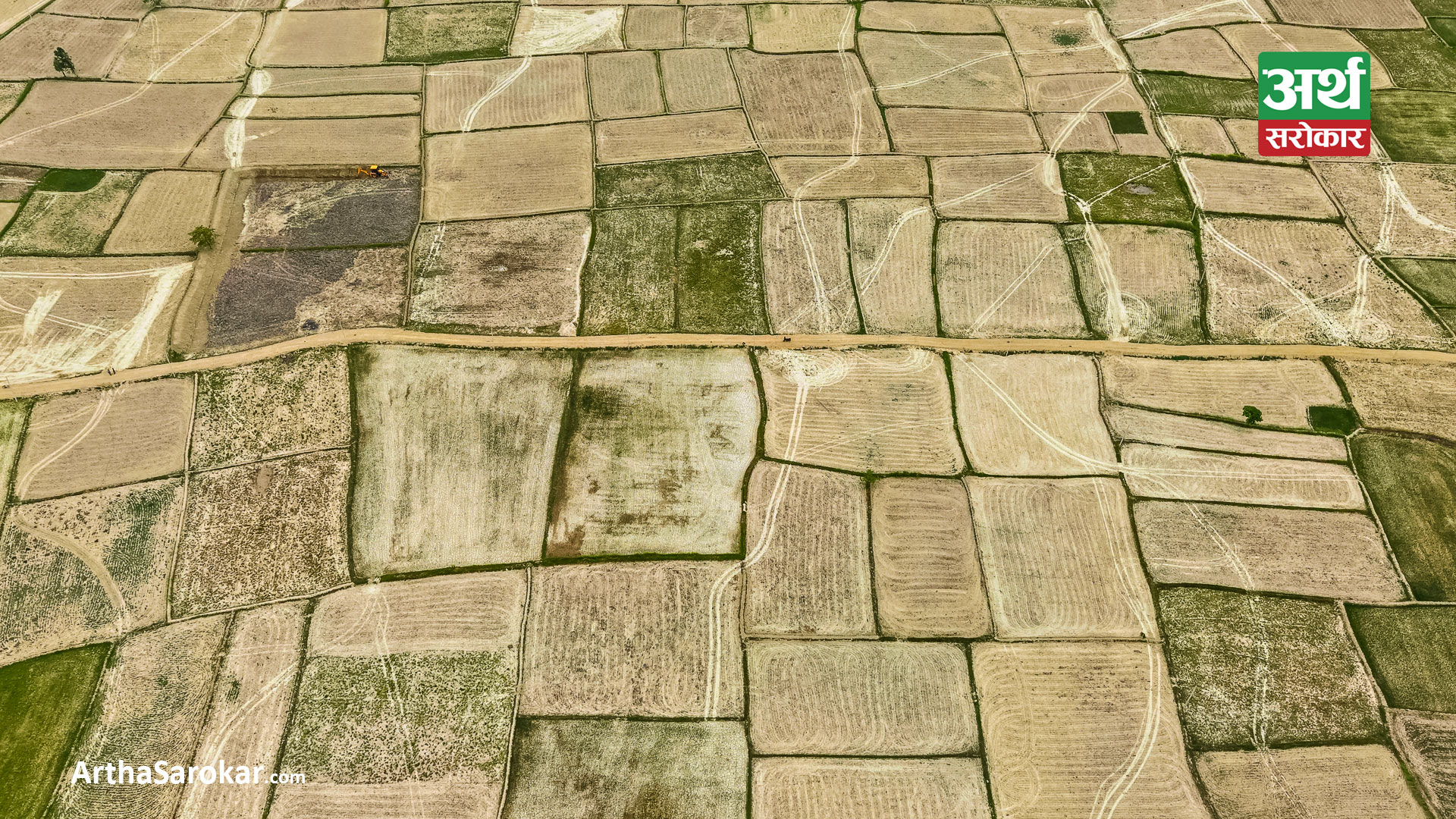
Kathmandu. In the last decade, the gap between investment and production in the agriculture sector has widened. Although the budget is increasing, production and fertile land are decreasing.
The production of major food crops has fluctuated from the fiscal year 2070/71 to 2080/81. Although the production of some crops has increased, traditional crops are facing crisis. The main food crops of Nepal are paddy, maize, wheat, millet and buckwheat.
The government has been increasing the budget for agriculture by 10.7 percent every year. The government had allocated Rs 21.40 billion in the fiscal year 2070/71 and Rs 59 billion in the fiscal year 2081/82.
According to the book ‘Nepal’s Agriculture Statistics Information’ published by the then Ministry of Agriculture and Livestock Development, in the fiscal year 2070/71, paddy was produced 5 million 47 thousand 47 metric tonnes, maize 2.2 million 83 thousand 222 metric tonnes wheat, 1 million 83 thousand 147 metric tonnes millet, 304 thousand 105 metric tonnes millet and 1335 metric tonnes buckwheat.
Besides wheat, rice, millet, buckwheat, and other commodities were imported from China, Argentina and Malaysia in recent years, according to data with the Department of Customs.
In the fiscal year 2081/82, Nepal imported 753,305 metric tonnes of rice, 299,989 metric tonnes of maize, 8,443 metric tonnes of millet and 698 metric tonnes of buckwheat.
In the fiscal year 2081/82, a total of Rs 59.92 billion was spent on the purchase of rice, Rs 19.27 billion for maize, Rs 423 million for millet and Rs 53 million for buckwheat.
In the same fiscal year, the government had allocated Rs 57.29 billion for the development of agriculture sector. This budget is 4.06 percent more than the import of Rs 2.63 billion for the development of agriculture.
According to the Central Bureau of Statistics, rice production is increasing by 1.034 per cent annually while population growth rate is 0.92 per cent per year. According to the 2021 census, the population of Nepal is 29.164 million.
According to Tilak Raj Chaulagain, senior agro economist at the Department of Agriculture under the Ministry of Agriculture, Forest and Environment, around 70 lakh metric tonnes of paddy is needed to feed a population of 30 million. The production of rice has to be increased by 13 lakh metric tonnes to feed the population.
In the fiscal year 2081/82, 3193,869 metric tonnes of maize was produced. Production has increased by 910,647 metric tons in the last 10 years. This is an increase of 3.98 percent year-on-year. Wheat production has increased by 8 percent to 2,035,559 metric tons. This is an increase of 0.8 percent per year.
The production of millet and buckwheat has fallen drastically in the last 10 years. In the fiscal year 2070/71, millet was 304,105 metric tonnes while in 2080/81 it was 24,931 metric tonnes. The production of millet has decreased by 22.1 percent annually.
Similarly, the production of buckwheat was 1335 metric tons in 2070/71 while it was only 14,516 metric tons in the fiscal year 2080/81. Buckwheat production has decreased by 17.6 percent year-on-year.
In the last 10 years, the government has increased the budget for agriculture by 10.7 per cent while the production of paddy has increased by 1.034 per cent per annum for maize, 3.98 per cent for wheat, 22.1 per cent for millet and 17.6 per cent for buckwheat.
On the other hand, arable land is also decreasing. According to the National Statistics Office, 2,525,639 hectares of land has shrunk to 2,218,410 hectares in the agriculture census of 2068 BS.
Agriculture census is being conducted in Nepal every 10 years. The census of agriculture was started from 2018 BS.








प्रतिक्रिया दिनुहोस्