



 Cinema Portal
 Election Portal
 Share Dhani Portal
 Unicode Page
 English Edition
 Share Training
 PREMIUM
 सुन-चाँदीको भाउ
 विदेशी विनिमयदर
 मिति रुपान्तरण
 पेट्रोलको भाउ
 तरकारी/फलफूल भाउ
 आर्थिक राशिफल
 आजको मौसम
 AQI Page


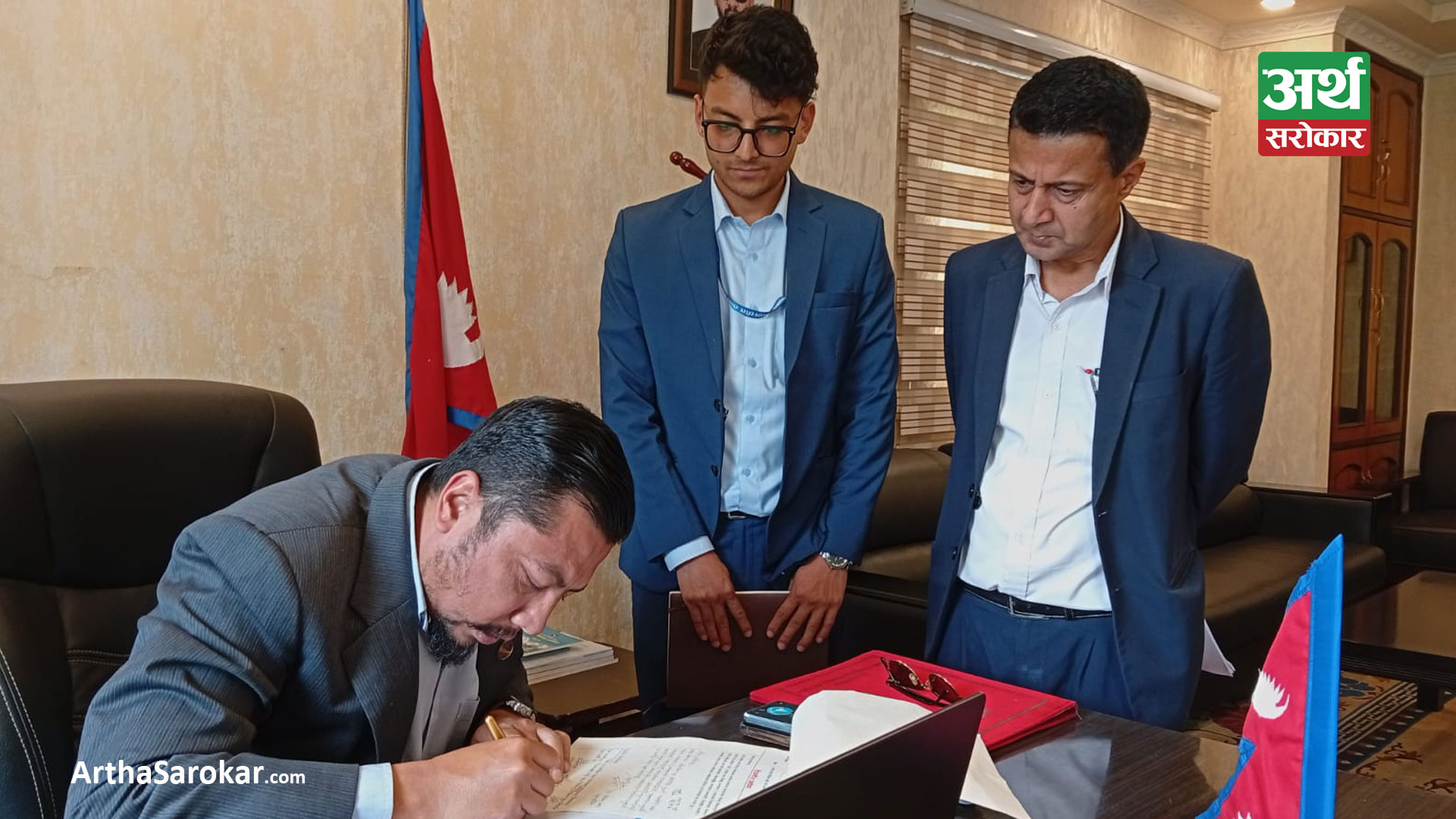
Kathmandu. Minister for Energy, Water Resources and Irrigation Biraj Bhakta Shrestha has issued directives to the concernedbodies to prepare a detailed action plan for structural reforms, increase transparency and result-oriented performance of the energy and water resources sector. The 32-point directive has been issued covering a multi-dimensional issue ranging from electricity market reform to ({{} ( (.
The Ministry has clearly assigned the responsibility to the concerned body to implement all the action plans within the stipulated time . There will also be regular intensive monitoring.
‘This directive has been issued after a long homework and intensive discussions with the stakeholders. Minister Shrestha said, “The directives have not been issued just to show this, our policies, plans and programs will now be prepared on the basis of this.” Therefore, I also direct the subordinate agencies and employees to complete the performance within the stipulated time and to follow up continuously. ’
In the directive issued by Minister Shrestha, the Electricity Regulatory Commission has been asked to determine the wheel ing charge within 30 days for the implementation of the ‘Open Access’ system.This is expected to open the door to competitive power trading between the private and public sectors. Reservoir and pumped storage projects will have different tariff structures based on seasonal and peak demand, which will balance the generation and consumption management.
Similarly, the Nepal Electricity Authority (NEA) has been directed to submit a report of PPA (Electricity purchase (Electricity purchase agreement) and with options for resolution.Out of the existing PPAs, have been categorized into the projects that are in operation, delayed and at risk and have been asked to submit a report with clear status. The decision is expected to boost investors’ confidence and help resolve the stalled projects.
In order to attract the private sector to reservoir-based projects, the policy will be brought to keep the license period of 50 years. The Electricity Regulatory Commission, Electricity Generation Company and National Transmission Grid Company have been asked to submit a report within 30 days by identifying duplication and necessary aspects of improvement.
Similarly, the Department of Electricity Development has been directed to make public the details of survey and construction licenses of all hydropower projects across the country within 60 days.This will include the license issuance date, progress, milestone and compliance status. Cure notices will be issued to companies that do not comply with the rules and new licenses will not be issued without review.
A plan has also been put forward to establish a publicly accessible ‘License Performance Dashboard’ and update it monthly. Grid evacuation has been made mandatory precondition for the development of new hydropower projects. New construction license will be issued after Nepal Electricity Authority (NEA) and National Transmission Grid Company confirm the capacity of the transmission line and substation.
For financial transparency, a detailed report on the process of collection and distribution of hydropower royalty should be made public. This will also ensure that the share received by the law has been properly transferred to the provinces and local levels.
As a new dimension in the energy sector, the ‘Carbon Revenue Unit’ will be established, it will set the criteria for the registration, certification and profit sharing of carbon trading projects. It is also expected to help reduce the cost of small projects.
The Nepal Electricity Authority (NEA) and the Alternative Energy Promotion Centre (AEPC) will jointly prepare a national demand and consumption plan to increase the internal consumption of electricity.A long-term power export roadmap will be prepared by making Nepal Power Trading Company fully active.
Giving priority to the use of new technology, the ‘AI Chatbot’ will be operated 24 hours a day to resolve consumer complaints and problems related to power interruption. Similarly, research and development will be encouraged by forwarding the ‘Green Hydrogen’ pilot project.
Similarly, a ‘hydrological series’ will be prepared by incorporating changes in the flow of rivers and the penalty system will be reviewed according to their impact on electricity generation.Implementation of river basin master plan, establishment of inter-country water resources unit, development of certified water and meteorological data system and groundwater monitoring program will be carried out. Groundwater management will be strengthened with digital surveillance system, especially in the Terai region.
Special emphasis has been laid on timely completion of national pride projects such as Babai, Bheri-Babai diversion and Sikta towards the irrigation sector.Diplomatic initiatives will be expedited with India for the Mahakali Irrigation Project and the Sunkoshi-Marin Project will be forwarded through the tender process. In order to make the ir rigation system sustainable, arrangements have been made to implement ‘Irrigation Service Fee’, to implement the Agro-Irrigation-Industry Integrated Plan and to prepare a drought-resilient strategy for the Tarai-Madhes region.







प्रतिक्रिया दिनुहोस्