

 Cinema Portal
 Election Portal
 Share Dhani Portal
 Unicode Page
 English Edition
 Share Training
 PREMIUM
 सुन-चाँदीको भाउ
 विदेशी विनिमयदर
 मिति रुपान्तरण
 पेट्रोलको भाउ
 तरकारी/फलफूल भाउ
 आर्थिक राशिफल
 आजको मौसम
 AQI Page


Kathmandu. The Gen-G movement that took place on September 23 and 24 last year has not only overthrown the old leaders, but has also created an unexpected rise of many.
During the period of one year of the Gen-G movement, an interim government was formed, a non-political face became the Prime Minister and a minister. This was followed by elections on March 21 from where the government was formed under the leadership of the RSP.
What happened from the destruction to Balen’s appointment as prime minister? Let’s look at the image:

September 23-24, 2082: Gen-G Movement
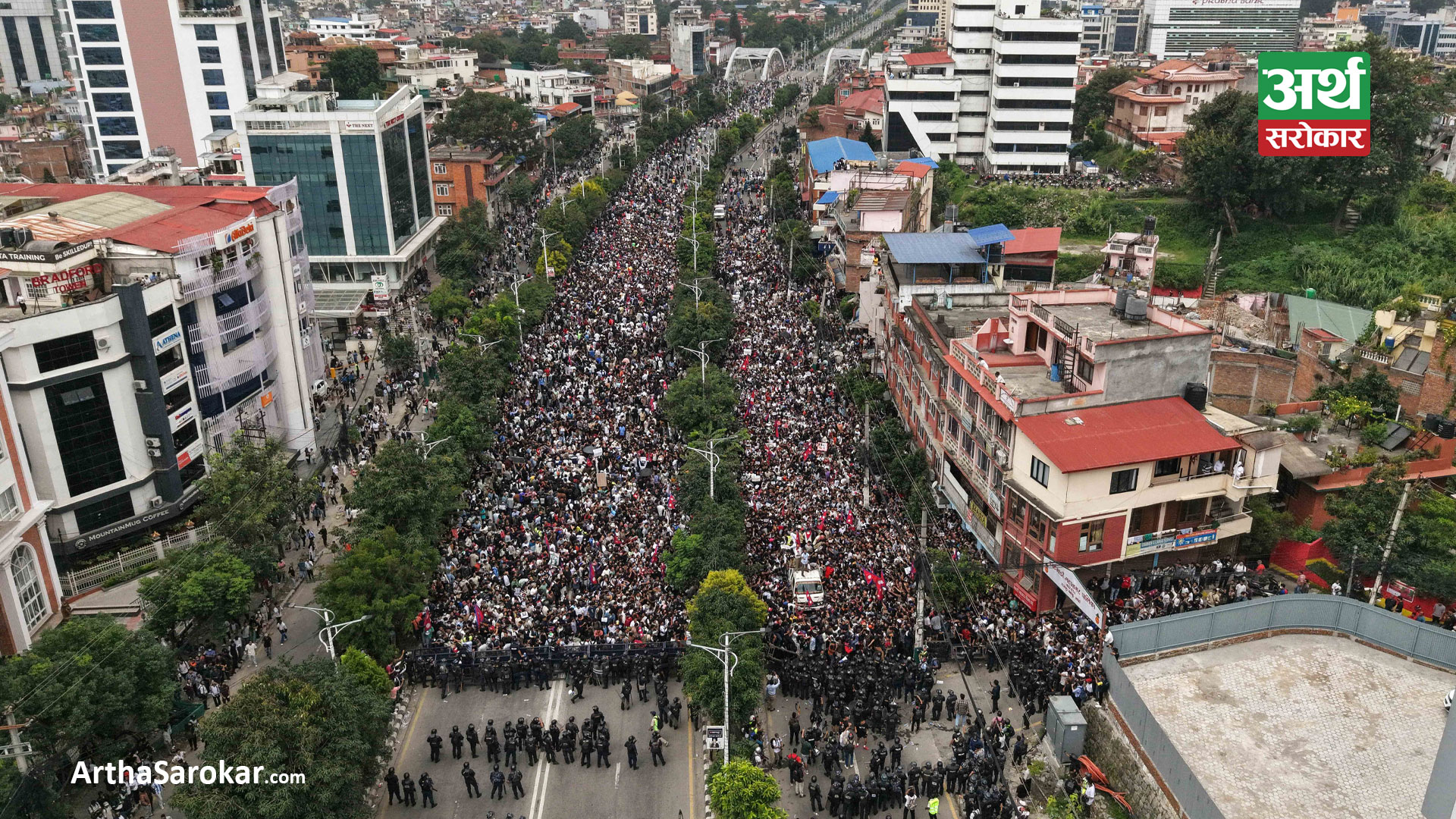
The government had banned social media platforms on September 19. The Gen-G generation united against the ban, against corruption and nepotism. After this, the movement was called. Teenagers and youths spontaneously came to Maitighar to participate in the movement.
The demonstration started from Maitighar Mandala and moved towards the Parliament House in New Baneshwor. It was from here that the Jenji movement took a fierce form.

On the first day, 19 people lost their lives due to the excessive use of force by the security personnel, including deadly weapons. After this, the protests intensified across the country. Due to the incident of the previous day, the agitation did not stop despite the curfew on September 24.

Singha Durbar, Parliament House, Prime Minister’s and Ministers’ residences, Rashtrapati Bhavan, courts and other government offices were torched and vandalized.


Another 50 people died.

When the situation went out of control, the then Prime Minister KP Sharma Oli resigned. The army tried to control the situation. The situation was brought under control only after Oli’s resignation, arson, and vandalism.
September 27: Formation of interim government
After discussions between the protesters and stakeholders (including online voting of the Gen-G group), it was agreed to make former Chief Justice Sushila Karki the interim prime minister. On September 27, President Ram Chandra Paudel appointed Karki as the interim prime minister. On the same day, the House of Representatives was dissolved and elections were announced on March 21.


Former finance secretary Rameshwor Khanal, former managing director of Nepal Electricity Authority (NEA) Kulman Ghising and advocate Om Prakash Aryal were appointed as ministers. They took oath of office and secrecy from President Ram Chandra Poudel on September 30 under a tent set up at Shital Niwas.

Balendra Shah (Balen) entered party politics during the election period from the formation of the interim government. On December 13, he formally joined the RSP. He was made the candidate of the Prime Minister of the RSP. He resigned from the post of Mayor of Kathmandu Metropolitan City in the first week of January. After this, he participated in the general election. 
Asoj 28: Deuba Released After 35 Days
During the Jenji movement, the then Congress President Sher Bahadur Deuba was brutally beaten up at his residence in Budhanilkantha. After this, he was in treatment and did not appear in public programs.

Deuba became public after 35 days of the incident. He had gone to the party office in Sanepa to attend the party’s central committee meeting held on October 28. After that meeting, Deuba handed over the responsibility of acting president to the then vice-president Purna Bahadur Khadka, saying that he would go abroad for treatment.
January 30: Gagan rises to the presidency
After the Jenji movement, there was turmoil in the major political parties. There was a debate that the old leaders should leave the leadership of the party and hand over the responsibility.
The leadership of the UML and the Maoists did not change. However, the internal politics of the Congress changed, the effect of which is visible from today onwards. The then General Secretary Gagan Kumar Thapa and other leaders united to remove Sher Bahadur Deuba from the post of President. They called a special general convention of the Congress, from where Gagan emerged as the president.

The special general convention was held from Poush 27 to 30, 2082 BS at Bhrikutimandap in Kathmandu. Thapa was elected unopposed as the President of the Congress on January 13, 2082 through the special general convention.
Of course, even before the Genji movement, Gagan wanted to come to the leadership of the Congress. However, after the movement, the events with resentment against the old leaders made Gagan more comfortable.
February 21: General Election
As per the previous announcement, the election to the House of Representatives was held on March 4. The RSP won an unprecedented majority of 182 seats. Balen Shah contested from Jhapa-5 and defeated former Prime Minister KP Sharma Oli.


Although it is said that a section of the Congress did not support Gagan in the elections because he was against Deuba. However, looking at the situation across the country, the results showed that the people of the old parties were not in a position to win the election. On top of that, Gagan’s defeat was due to the increase in Balen’s personal and RSP’s influence in Madhes.
One of the most memorable events of the last year is the entry of the Labour Culture Party into the parliament for the first time after the old party suffered an irreparable loss.
Chait-12 : Oath of MP
Those who won the election to the House of Representatives on March 4 were sworn in on March 26. The senior-most member Arjun Narsingh KC administered the oath of office and secrecy to the 274 elected members. After this, the RSP made Balen the leader of the parliamentary party.

March 13: Appointment of Prime Minister
President Ram Chandra Poudel initiated the process of appointing the Prime Minister after the swearing-in of the MPs the previous day. He appointed Balen, the leader of the Rastriya Samajwadi Party (RSP), as the Prime Minister on March 13.


President Paudel appointed Balen as the Prime Minister in accordance with Article 76 (1) of the Constitution. Balen took the oath on March 27 at 12:34 pm. With this, he became the first Prime Minister of the Madhesi community at the age of 36. He also appointed 14 ministers in the first phase.
Chaitra 14: Ollie–author arrested
A day after Balen Shah became the Prime Minister, former Prime Minister and UML Chairman KP Sharma Oli and Congress leader and former Home Minister Ramesh Lekhak were arrested. They were charged with murder in the deadly crackdown on protesters during the agitation and the death of more than 70 people.


When the government did not make adequate preparations, there was no evidence to keep them in custody and take further action. As a result, the Supreme Court ordered not to extend the remand for the fourth time and release them from custody if the investigation is not completed. After this, Oli-Lekhak was released after 13 days in custody.





प्रतिक्रिया दिनुहोस्