


 Cinema Portal
 Election Portal
 Share Dhani Portal
 Unicode Page
 English Edition
 Share Training
 PREMIUM
 सुन-चाँदीको भाउ
 विदेशी विनिमयदर
 मिति रुपान्तरण
 पेट्रोलको भाउ
 तरकारी/फलफूल भाउ
 आर्थिक राशिफल
 आजको मौसम
 AQI Page


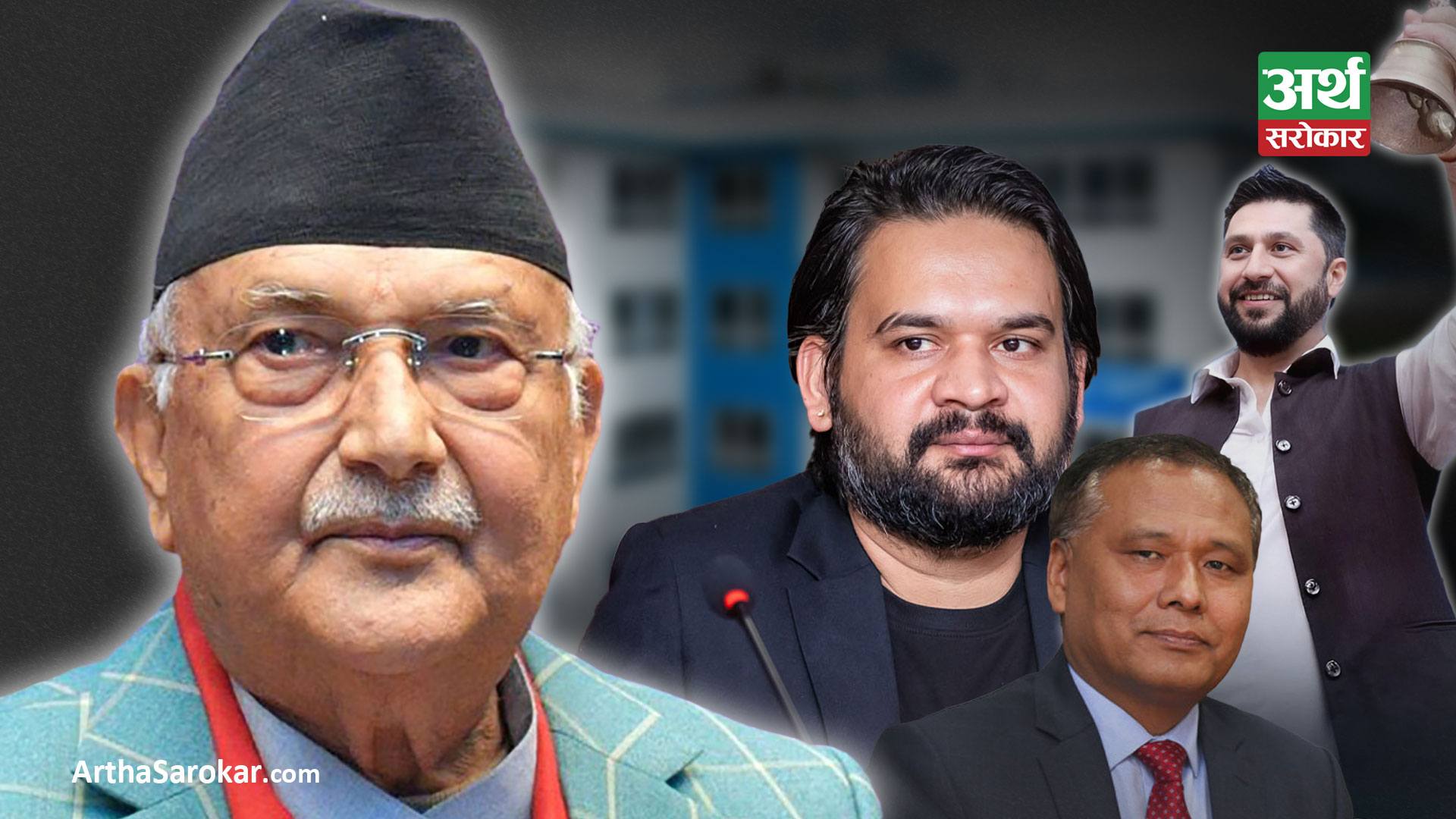
Kathmandu. Politically, the year 2082 was very tumultuous. But towards the end of the year, the country received clear guidelines with a new mandate for peace, stability and prosperity. In the middle of the year 2082, the rebellious movement of ‘Gen-G’ has played an intervening role in taking the politics of a new way.
The country got a new government after the dissolution of the then government and dissolution of the House of Representatives on the strength of the Gen-G movement and the civil government formed under the leadership of former Chief Justice Sushila Karki held the elections to the House of Representatives on March 4. In the election, the ruling and old political parties were defeated and the National Swatantra Party managed to get almost two-thirds mandate.
These parties, which were leading Nepal’s democratic movement, have shrunk politically towards the end of 2082. There has been a change in the party under the leadership of Gagan Kumar Thapa following the special general convention of the Nepali Congress. The issue of legitimacy within the Congress is still pending in the court.
KATHMANDU: The CPN-UML has successfully held its second statute general convention and eleventh national general convention this year. In the context of the re-election of KP Sharma Oli to the leadership of the party, the question of political generation has not been free from criticism. After the defeat in the House of Representatives elections, the debate on special convention or generational transfer has intensified in the UML.
The Communist Party of Nepal (CPN), which participated in the election by incorporating more than two dozen leftist groups and political groups, also failed to produce the expected results in the elections. The party led by Pushpa Kamal Dahal ‘Prachanda’, which was the mainstream of the then CPN (Maoist) that emerged from the ‘People’s War’, is now preparing for a special general convention. Influential leaders of the party, Janardan Sharma and Sudan Kirati, among others, left the party, questioning its policy and leadership.
The year 2082 marked the year when the old parties were criticized and the new political parties emerged as a big party. This time, the Rastriya Swatantra Party (RSP) alone won 182 seats, ending the narrative that the government should be formed by forming an alliance. This is the first time that a single party has secured a clear majority in the elections after the promulgation of the Constitution of Nepal, 2072.
As per the pre-election resolution, the party appointed senior leader Balendra Shah as the Prime Minister. The dissolution of parliament, elections and the formation of a new government were the important political events of this year. According to Article 76 (1) of the Constitution of Nepal, Shah was appointed as the Prime Minister on March 27.
The present government led by Shah is comparatively inclusive, remarkably youth-representative and small in size and has implemented 100 agendas related to governance reforms as per the promises made during the election since its very beginning.
With Prime Minister Shah assuming the reins of power, there are clear indications that the shortcomings seen in the past will not be repeated. It is seen that Prime Minister Shah, who had delivered the message and priorities of the new government through the group meeting of the chiefs and ambassadors of the diplomatic missions in Kathmandu, has focused special attention on systemic reforms of the state mechanism.
These positive efforts of the government are believed to be a source of inspiration for the reformed politics of the year 2082 for the coming year. Centenarian and former member of the National Human Rights Commission, Gauri Shankarlal Das, said the year 2082 was seen as a political tsunami. The government should move ahead as per the aspiration of the people, he said, adding that the initial steps taken by the incumbent government are very positive.
The House of Representatives, formed through the election, has also elected its leadership in the meantime. Dol Prasad Aryal and Ruby Kumari Thakur have been elected Speaker and Deputy Speaker respectively. President Ram Chandra Poudel addressed a joint meeting of both houses of the Federal Parliament after the election to the House of Representatives today.
On September 7 and 24 of this year, 76 people were killed during the uprising. 45 people were declared ‘Genji Good Fighters’ and relief and compensation were provided by the state. During the agitation, the main administrative center of Nepal, Singha Durbar, the Federal Parliament Building, the Supreme Court, Shital Niwas and other important heritages were destroyed in the fire. According to government data, the government and private sectors have suffered a loss of around Rs 76 billion.
In the year 2082, the Federal Civil Service Bill became a popular phenomenon. The political lobbying by the Chief Secretary and high-level employees of the civil service administration and the negligence of the committee chairperson regarding the ‘cooling period’ in the bill passed by the State Affairs and Good Governance Committee of the House of Representatives has been recorded as a shameful incident in the parliamentary history.
In the meeting of the House of Representatives this year, the issue of irregularities in the ‘visit visa’ was not only raised in a fiery manner but the then opposition party Rastriya Swatantra Party had obstructed and boycotted the House for a long time demanding the resignation of the then Home Minister Ramesh Lekhak.
The arrest of then Prime Minister KP Sharma Oli and then Home Minister Ramesh Lekhak on the recommendation of a high-level commission formed to investigate the incidents of the Genji movement has also been a topic of national and international discussion. They have now been released on bail as per the court order.
The Sagarmatha Sambad concluded in Kathmandu in a grand manner in the first week of May this year to bring the world community together on the issue of climate change. Through this international conference, Nepal has been able to make the issue of security from the mountains to the sea of global importance.
Major developments in the political, economic and social sectors in the year 2082:
KATHMANDU: Former Minister of State for Health and former President of Nepali Congress Kathmandu Tirtha Ram Dangol passed away at the age of 77.
April 30: The government and teachers and employees who have been staging street agitation for the past 29 days have signed a nine-point agreement.
Leftist leader Pradip Nepal passes away at the age of 71.
May 13: Sagarmatha Samvad concludes, 25-point announcement.
May 6: Dr. Ram Chandra Poudel appointed as Governor of Nepal Rastra Bank Bishwa Paudel appointed.
May 7: Immigration Joint Secretary Tirtha Raj Bhattarai arrested on the charge of human trafficking on visit visa.
May 27: Kami Rita Sherpa breaks her own record by climbing Mt. Everest for the 31st time.
May 29: The government presented a budget of Rs 1,964.11 billion for the fiscal year 2082÷83.
June 15: Nepal Electricity Authority (NEA) starts exporting electricity to Bangladesh.
Former Minister and former central member of Nepali Congress Dhundiraj Shastri passed away at the age of 90.
June 19: Dailekh confirms 112 billion cubic meters of natural gas.
June 10: Government forms high-level committee to investigate the visit visa issue.
June 15: House of Representatives passes Civil Service Bill.
July 9: Nine people died and 19 went missing in a flash flood in Lhende rivulet of Rasuwa district that flows through the Nepal-China border.
July 22: Nepal rescues 47 Nepali women from jail in Iran.
Sept. 9: At least 19 people were killed in a demonstration by the Genji generation in Kathmandu. Home Minister Ramesh Lekhak resigns on moral grounds after protests turned violent and killed a large number of youths.
September 24: Prime Minister KP Sharma Oli resigns. Rastriya Swatantra Party lawmakers announce mass resignation.
September 25: 11,505 prisoners escaped from jail.
President Ram Chandra Poudel appoints former Chief Justice Sushila Karki as Prime Minister. Recommendation for dissolution of House of Representatives immediately after swearing-in of Prime Minister. Eight political parties disagree on the dissolution of the House of Representatives.
September 13: Government decides to declare the martyrs and provide compensation of Rs 1.5 million to the families of the martyrs during the Zenji movement on September 9 and 24.
Sept 22: Government forms a high-level judicial inquiry commission into the Jenji agitation on September 7 and 24.
Sept 8: Govt focuses on reconstruction and elections, decides to drastically cut government expenditure.
Sept 26: The National Human Rights Commission (NHRC) has made public its monitoring report on the incidents that took place during the demonstrations of the Genji generation on September 7 and 24. Allowances to former political and administrative officials retired by the government except as per the approved criteria mentioned in the prevailing laws.
October 26: The High Level Judicial Inquiry Commission formed to investigate and study the Jenji agitation of September 7 and 24 has written to the then Prime Minister KP Sharma Oli and five others to be banned from foreign travel.
October 7: The government has decided to provide grants to those who lost their homes due to floods and landslides caused by incessant rainfall from October 1 to 19 for the construction of temporary houses.
October 11: Former Prime Minister and Nepali Congress President Sher Bahadur Deuba has appointed Vice-President Purna Bahadur Khadka as the acting president.
October 14: Kathmandu District Administration has banned gatherings, demonstrations, sit-ins and rallies at different places for two months.
November 28: Supreme Court refuses to issue interim order on writ petition against government and dissolution of House of Representatives.
November 30: Government declares 45 people killed in various districts including Kathmandu as martyrs during the Zenji movement.
November 3: Nepal Communist Party (Maoist Centre), Nepal Communist Party (Unified Socialist) and 10 leftist parties announce unification.
November 19: National Security Council recommends to the Council of Ministers to mobilize the Nepal Army for the security of the House of Representatives elections scheduled for March 4.
December 9: Cabinet endorses the government-Genji agreement, decides to publish the 10-point agreement signed between the Prime Minister and the Genji representatives in the gazette.
December 14: The government forms a high-level political dialogue committee to hold talks with various political parties and stakeholders to ensure the House of Representatives elections on March 4.
Kathmandu, Dec 17: KP Sharma Oli has been re-elected as the chairman of the CPN-UML.
Kathmandu Metropolitan City Mayor Balendra (Balen) Shah and Rastriya Swatantra Party (RSP) President Rabi Lamichhane signed a seven-point agreement.
15th session of Nepali Congress adjourned.
Poush 2: Nepali Congress decides to extend term of the working committee elected from the 14th General Convention till mid-June 2083 and hold the 15th general convention in coming April.
Poush 3: The Commission of Inquiry into the incident of September 7 and 24 gives statement of CPN (UML) Chairman and former Prime Minister KP Sharma Oli.
KATHMANDU, Jan 10: Former minister Kulman Ghising has been appointed as the chairman of the Ujyalo Nepal Party, after 12 days of the unification with the Rastriya Swatantra Party (RSP).
Jan 10: Nepali Congress’s second special general convention begins.
January 14: The Election Commission (EC) has given legitimacy and official recognition to the central working committee led by Nepali Congress President Gagan Kumar Thapa, who was elected from the second special general convention of the Nepali Congress.
January 4: Nepali Congress’s internal dispute moves to court.
March 21: Election to the House of Representatives held peacefully across the country simultaneously.
March 24: Nepali Congress leader Arjun Narsingh KC sworn in as the senior-most member of the House of Representatives.
March 12: Senior-most member of House of Representatives, Arjun Narsingh KC, sworn in as lawmakers.
March 29: Rastriya Swatantra Party (RPP) Parliamentary Party leader Balendra Shah appointed as the Prime Minister, formed a 15-member cabinet.
March 14: Former Prime Minister KP Sharma Oli and then Home Minister Ramesh Lekhak have been arrested for investigation.
April 22: Dol Prasad Aryal elected Speaker of House of Representatives.
April 26: Court releases former Prime Minister KP Sharma Oli and former Home Minister Ramesh Lekhak on present bail.
April 27: President Ram Chandra Poudel addresses a joint meeting of both houses of the Federal Parliament.






प्रतिक्रिया दिनुहोस्