



 Cinema Portal
 Election Portal
 Share Dhani Portal
 Unicode Page
 English Edition
 Share Training
 PREMIUM
 सुन-चाँदीको भाउ
 विदेशी विनिमयदर
 मिति रुपान्तरण
 पेट्रोलको भाउ
 तरकारी/फलफूल भाउ
 आर्थिक राशिफल
 आजको मौसम
 AQI Page


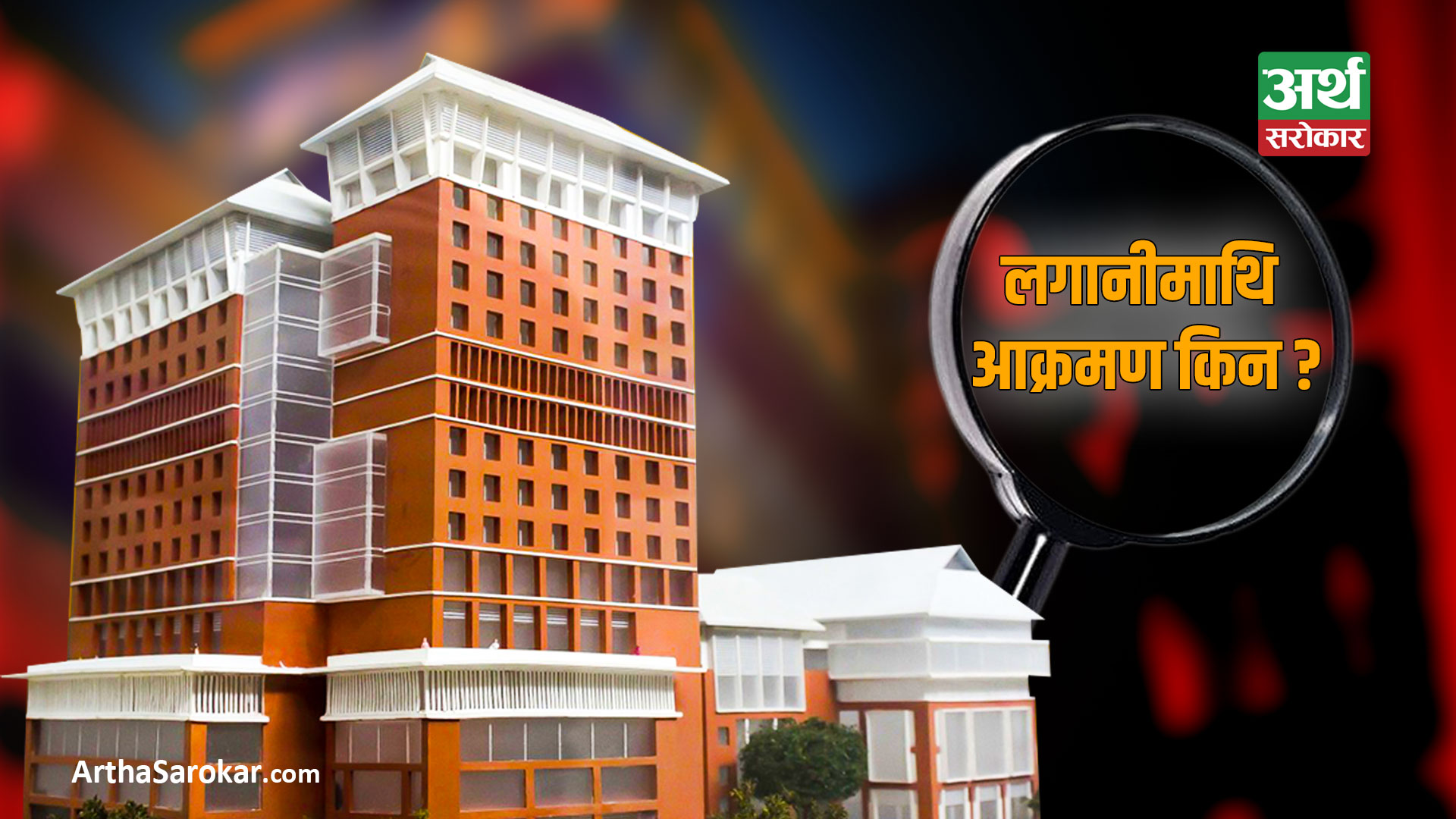
Kathmandu. The country is in the grip of an economic crisis, a lack of investment and an exodus of youth. On the one hand, the government is announcing to attract foreign and domestic investment, encourage the private sector, revive the tourism industry and create investment-friendly environment. From the Prime Minister of the present government to the Finance Minister, there are repeated speeches of that ‘prosperity is not possible without the private sector’. But on the other hand, on the other hand, when the business projects built after completing the legal process have been the target of controversy, publicity, mental pressure, and fabricated rhetoric for years, what will be the future of investment in Nepal? A serious question has begun to arise.
The Chhaya Complex in Thamel is now at the center of this debate. The modern business complex, which was once constructed with the aim of elevating Nepal’s tourism sector at the internationallevel, is now in the midst of such publicity that it has created a situation affecting not only a single building or business, but also the overall investment, environment and tourism market of Nepal ।
For years, social media, various groups and some activists have been accusing the Chhaya Complex of ‘heritage encroachment’,‘building built by grabbing the land of Guthi by the mafi a’, ‘project to destroy the culture of Thamel’.However, one thing is clear when we look at the government records, court orders, administrative approvals, map approvals, land revenue records and the judicial situation during the construction of the building. The shadow complex was not a structure built overnight or erected illegally. The project was built within the state’s legal process, government approvals and administrative systems. On the other hand, Thamel ‘Amrit Marg’ was built at a time when it has less commercial importance than other areas, this commercial has changed the business ground of the place local businessmen. The locals are happy with the construction of complet for their contribution to the preservation of the local Bhagwan Bahal temple.
This is the reason why many entrepreneurs have started asking – “If a project approved by the state remains unsafe for years, then who will invest in Nepal?”’

Dream of creating an international tourism ‘hub’
In 2008, an advertisement was published for the sale of about 12 ropanis of land in Thamel. A company named Suresh Saraya Housing, which is associated with the family of Keshar Shumsher, the grandson of Jung Bahadur Rana, had put the land up for sale. Although Thamel is the main tourist market of Nepal, there was a lack of modern tourism infrastructure of international standards. Seeing this need, about 45 small and big businessmen and interested citizens came together. Their aim was not only to do business but also to develop Thamel as a new level tourist destination. The image of cheap and unorganized tourism market was to be changed to a modern tourism complex with hotels, business centers, entertainment and service facilities of international standard.
In the year 2065 B. S., ‘Chhayadevi Complex’ was registered. The company was established under the chairmanship of Prithvi Bahadur Pade, a prominent personality in the private banking sector of Nepal, and businessmen who invested between Rs 1 million to Rs 10 crore were involved in the company.
According to the construction party, all the legal procedures were completed before starting the project.The map was approved by the Kathmandu Metropolitan City. The EIA was completed by the Ministry of Environment and a planning permit was obtained from the Valley Development Authority. The entire process of public hearings at the local level as well as the impact on the surrounding settlements was completed. After that, the construction work started only in 2069 BS. But after the construction started and the investment was made, many disputes were made.

The legal process was completed, but the dispute did not stop
As soon as the construction of the Shadow Complex began, various groups started going to court to stop the construction. In 2070 BS, some people, including Bhagwat Narsingh Pradhan, filed a petition at the Kathmandu District Court, claiming that this is the land and pond area of Bhagwan Bahal Guthi. However, the court did not order to stop the construction.
Advocate Dipendra Bikram Mishra, who has been filing cases for public concern, filed a case at the Supreme Court demanding a stay on the construction of the land, saying that this is government and historical land.That too was revoked. In 2014 BS, the Advocacy Group for Human Rights of Indigenous Peoples of Nepal (LAHURNIP) filed another lawsuit against the United Nations, citing the ILO 169 Treaty of the United Nations, claiming that this is an indigenous cultural site. According to ILO 169, settlements of any indigenous people cannot be demolished and developed. In that case too, the Supreme Court ruled not to stop the construction.
According to the construction party, the project gained momentum only after the court ordered not to stop the construction on all three petitions.So far, no court has ordered that the construction of the Chhaya Complex is an illegal structure. However, in the public discourse, the issue of the case in the court has been presented as ‘evidence of illegality’ and the media and social media have tried to demoralize the businessmen.

Legends of Guthi, Pond and History
The main basis of the dispute related to the land of the Chhaya Complex has become the history, pond and Guthi. It is found in history that this area was once associated with Bhagwan Bahal Guthi. According to history, the local Bhagwan Singh Sarth Bahu Guthi had 5,000 ropanis of land in his name. Currently, there are about 5,000 ropanis of land from Narsingh Chowk to Galkopakha, Pipalbot, road to east and from Chhaya Complex to west and Samakhusi, Manamaiju and Nuwakot and other parts of the country. Bhagwat Narsingh Pradhan, the main character in the case against Chhaya Complex, also owned the ancestral house and land in Thamel. It is also true that there was a pond in ancient times. However, according to the construction team, it was not treated as a ‘heritage of national importance’ as is now being propagated.
v. No. In 1967, as per the ‘Tok Sadar’ of Rana Prime Minister Chandra Shumsher, 26 ropanis of land belonging to Bhagawan Guthi was merged with the palace of Keshar Shumsher. At that time, the king’s order was pramangi and Shree 3 Maharaj’s ‘Tok Sadar’ was above the law of the land. In 1977, Keshar Shumsher enclosed the high wall and brought the palace into private use, without any public activityand entry of outsiders, according to the construction parties. As far as picking and offering lotus flowers and throwing away the shraddha pedal, it is not a matter of time. No. Before 1967, it was common to have open land and ponds. However, after it was merged with ‘Keshar Mahal’ from ‘Tok Sadar’ in 1967, it remained purely for the personal use of Keshar Shamsher. There are no temples, no fairs, no festival rituals. The businessmen argue that they have built it because there is no such solid basis. During the Rana period, according to the king’s dictatorship. In 1967, the land was transferred in the name of Keshar Shumsher. After that, cases were filed in the court, Guthi Sansthan and the Land Revenue Office for decades.
In 2030 B. S., the District Court, Kathmandu, declared Keshar Shumsher’s side as the owner and tenant of the land.In 2031 BS, the regional court also upheld the same decision. Finally, according to the settlement reached in the Supreme Court in 2033 BS, Keshar Shumsher left the right of the landowner and only the tenant remained the tenant and the landowner Bhagwan Singh Sarth Bahu Bhagwan Guthi remained. In 2039 B. S., a land ownership certificate was officially issued in the name of Keyur Shumsher. According to the then Act, Keyur’s wife Ambika Rana worked as a raker in the Guthi Sansthan as per the rules. Although the case was filed against him, Raker was approved by the District Court in 1991 and the Appellate Court in 2053 BS. The then government had brought an act allowing the land of Guthi to be registered after 2046 BS. Accordingly, three lakh fifty thousand ropanis of land in the whole country except Madhesh were raised. In the case raised again by Bhagwan Bahal Guthi in 2058 B. S. In 2062 BS, Thakali of Guthi was reconciled with the district court under the leadership of the then Supreme Court Justice Hiranya Man Singh Pradhan for Rs 15 million and four anna of land. The same land was purchased in 2064 BS from Sureshaya Housing and Shankar Bikram Shah.
The question of the construction party is, “If the structure built on the land purchased on the basis of the land issued by the state is said to be illegal after decades, then how can we trust the legal system of the state?” And on what basis should businessmen invest?”

Commentary on ‘Heritage Demolition’ created on social media
Most of the publicity against the shadow complex was done through social media. The building was painted using terms such as ‘heritage destroyed structure’, ‘project to destroy Thamel culture’ and ‘encroachment on Guthi’. However, the available government documents and the judicial situation do not seem to substantiate these claims.
According to sources close to the construction team, an attempt has been made to influence public opinion by making a commentary that ‘heritage has been encroached upon’. As much as the protests and indecent attacks are seen on social media, the first heirs of the heritage and the local people have not complained about the complaint and they are happy. Locals say that those protesting against the shadow complex are not the residents of Thamel but people from other places are misleading them through legal hassles and social media. The working committee of the local Bhagwan Bahu Guthi had also issued an official letter a few years ago stating that there is no dispute with the shadow complex as some people from other parts have strongly protested. Not only this, the businessmen claimed that even after the operation of the shadow complex, the businessmen were treated like criminals. Some businessmen complain that they are afraid to do business openly due to public criticism, mental pressure and social attacks.
Psychological terror on investors?
The Chhaya Complex controversy has further raised the question of how safe is private investment in Nepal. On the one hand, the government is announcing to organize an investment summit, attract foreign investment, call the private sector a ‘partner of economic prosperity’ and create investment-friendly environment. On the other hand, there has been a growing tendency for years to drag projects built by domestic entrepreneurs with the permission of the state into controversies, discredit them socially, repeat old issues and mentally exhaust businessmen.
Businessmen associated with the shadow complex say, “We invested according to the legal process given by the state, we passed the map.” We paid taxes. We created jobs. We expanded the tourism market. But at the end of the day, why are we being made like criminals?”

Concerns affecting the tourism market
The Shadow Complex is not just a commercial building. This is a project directly related to the tourism economy of Thamel. It has played a role in hotels, trade, entertainment, service sector and job creation. However, entrepreneurs say that the controversy and publicity that has been going on for years has sent a negative message to Nepal’s tourism market.
According to them, there is a danger that Nepal will be portrayed as an insecure, controversial and negative foreign country in the international arena.They worry that such developments could discourage groups, especially those who want to invest heavily in the industry.
Development or emotional politics?
Heritage conservation is necessary. It is also the responsibility of the state to protect the historical and cultural identity of Kathmandu. However, the Shadow Complex controversy has also raised another question: Is emotional politics being played in the name of heritage conservation? Once the legal interpretation has been resolved, the issue is to terrorize the entrepreneur by filing a lawsuit again and again and making them in legal trouble. ’
If a project is publicly portrayed as ‘illegal’ without a final decision by the courts, they argue, it undermines not only the business, but also the justice system. According to them, there is a need to strike a balance between development and heritage conservation. But that balance has to come from legal standards, clear policies and transparent processes, not through mob pressure and social media commentary.

Security of investment or persistent insecurity?
The Shadow Complex controversy has sparked a serious debate on Nepal’s investment climate today. “What will be the future of the private sector in Nepal if a project that has been ordered by the court not to stop the construction after completing the legal process, getting approval from the state and getting an order from the court not to stop the construction becomes a victim of controversy, publicity and mental pressure for years?”
Heritage conservation is necessary, but in the name of this, the tendency to terrorize businessmen by creating historical legends, emotional propaganda and fabricated commentary has raised concerns that it could eventually be detrimental to the country’s economy, tourism market and investment climate. What is needed today is facts, law and a balanced point of view rather than accusations and propaganda. Because, if the private sector continues to be made insecure, the dream of a ‘prosperous Nepal’ can be limited to mere speeches.






प्रतिक्रिया दिनुहोस्