


 Cinema Portal
 Election Portal
 Share Dhani Portal
 Unicode Page
 English Edition
 Share Training
 PREMIUM
 सुन-चाँदीको भाउ
 विदेशी विनिमयदर
 मिति रुपान्तरण
 पेट्रोलको भाउ
 तरकारी/फलफूल भाउ
 आर्थिक राशिफल
 आजको मौसम
 AQI Page




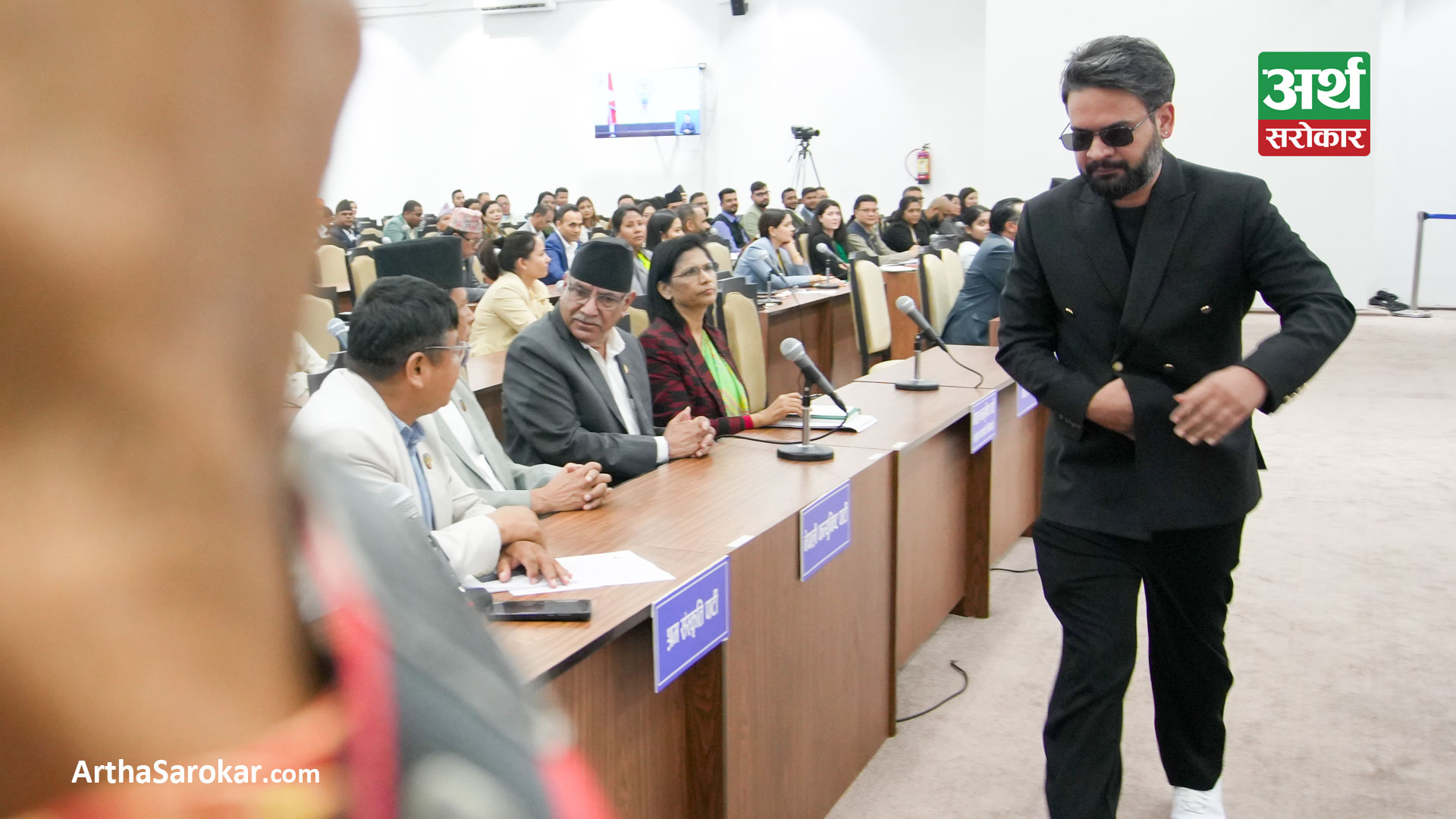
Kathmandu. The government has unveiled an ambitious budget of Rs 2,124.34 billion for the fiscal year 2083/084 BS and presented a blueprint for economic transformation through production growth, digital economy, information technology, participation of private sector and administrative reforms. Finance Minister Dr. The government has described the budget presented by Swarnim Wagle in the parliament as the basis for economic renaissance. But looking at the priorities of the budget, resource management, increasing burden of debt, the pressure of current expenditure and the poor implementation situation of the past, the reality seems to be pointing in a different direction from the government’s announcement.
While the budget claims to prioritise manufacturing, technology and the private sector, a large part of it is still focused on salaries, allowances, administrative expenses and debt repayment. Out of the total budget, Rs 1,270 billion has been allocated for recurrent expenditure, which is about 60 percent of the total budget. Of the total capital expenditure, only Rs 431 billion has been allocated under the heading of financial management. A large amount of this amount will be spent on paying the principal and interest of the public debt.
With Nepal’s public debt crossing Rs 29 trillion, more resources have to be spent on debt management than development expenditure. As a large part of the revenue is spent on repaying debts, the government’s ability to develop gradually weakens. Although the budget talks about production and employment, there are signs that the financial base required for it is shrinking due to the pressure of debt.
The government has announced to reduce the number of ministries from 22 to 18, dissolve 31 government bodies and restructure the administrative structure. The decision is seen as a positive step towards administrative reforms. But this time also doubts have arisen as there have been many such announcements in the past, but the implementation has not yielded effective results. Resistance to political division and bureaucracy seems to be a bigger challenge than structural reforms in the government machinery.
One of the most talked-about aspects of this year’s budget is the focus on information technology and artificial intelligence (AI). The government has announced the establishment of a sovereign AI compute center for the first time. The goal is to purchase thousands of AI processing units to provide subsidized value to youths, legalize remote work, provide tax exemption to start-ups and move Nepal towards digital economy.
Although the government’s efforts to create technology-based employment at a time when the youth are migrating abroad, the people of Nepal are apprehensive about the implementation aspect. At a time when Nepal still lacks basic digital infrastructure, high-speed internet, skilled manpower and research culture, there is a risk that AI-centric programs will be limited to announcements.
In order to encourage the private sector, the government has increased the limit of personal income tax and reduced the maximum tax rate from 39 percent to 29 percent. Customs duty on industrial raw materials has been reduced. Excise duty has been removed on 360 types of goods. Startup companies will be exempted from income tax for five years. The NRNs have been opened to invest in the secondary market.
These provisions are expected to provide some relief to the private sector. But businessmen still point to the government’s policy instability, administrative hassles, investment security and weak market demand as major problems. The private sector is looking for more policy stability and investment-friendly environment rather than tax exemption.
With the objective of commercializing the agriculture sector, provision has been made to provide up to 40 percent subsidy on land bank, contract farming, production-based subsidy, digital fertilizer distribution system and agricultural investment. Although the government’s goal of increasing agricultural production and substituting imports is positive, the past experiences are not encouraging. The real benefits of the programme have not reached the farmers due to irregularities in the distribution of agricultural subsidies over the years, the capture of the people with access and weak monitoring.
In the energy sector, hydropower production and export have been continued. Construction of Budhigandaki Hydropower Project has been announced. Under the infrastructure development, fast-track, highway upgradation, railways and digital infrastructure have been prioritized. However, the fact that the government’s capacity to spend the capital budget has been very weak in the past has made the goals challenging this time.
As for the media, which plays an important role in establishing democracy, it has not come up with any other plan except to continue the welfare advertisements. Moreover, the amount of money allocated to online media seems to have been cut.
Despite the increase in the budget for the education sector, the pace of improvement seems to be relatively weak. Digital education, skill-based education and research have been emphasized. A plan has been brought to provide employment opportunities to the students along with their studies through the “Learning and Earning” program. However, there are still unclear concrete structural programs to improve the quality of public schools, teacher management, university reform, and link the education system to the labor market.
In the health sector, restructuring of health insurance programme, expansion of telemedicine and maternal and child health have been prioritized. However, the decision to charge health parity fee from patients seeking treatment in private hospitals is likely to increase the cost of health services. Similarly, the education sector is expected to become more expensive due to the additional tax imposed on private schools.
Although the budget has provided some tax relief to the middle class, the policy of VAT on electricity consumption, additional financial burden on education and health sector has also increased the risk of adding more burden to the citizens than relief. On the one hand, the government wants to increase the use of clean energy, while on the other hand, it is adding a tax burden on electricity consumption of more than 50 units. Such a policy itself is being criticized as contradictory.
Another important weakness of the budget is in the context of inclusive development. Programmes aimed at Dalits, indigenous nationalities, Madhesis, Muslims, Tharus, landless, marginal farmers and people with disabilities have been found to be relatively weak. Although the slogan of social justice has been repeated in the budget, there is no concrete program and adequate resource allocation to implement it.
Although the main essence of federalism is to strengthen the local level, the financial equalization grant has been reduced. This has raised concerns that the development and social programs run by the local government could be affected. The tendency to concentrate power at the center by reducing resources at the local level is against the spirit of federalism.
The government has set ambitious goals to increase economic activities, create employment, increase production and attract investment. But in the past years, the problems of low capital expenditure, disorganized contracting system, projects not being completed on time, corruption control not being effective and good governance being weak persist.
According to analysts, Nepal’s problem is not the size of the budget, but the weakness in its implementation. Although a new program is announced every year, the results have not reached the level that the citizens can feel. For this reason, the question of whether this year’s budget will be successful in bridging the gap between the announcement and the reality is under question.
Overall, the budget 2083/084 has tried to make the economy dynamic by focusing on production growth, digital transformation, participation of the private sector and administrative reforms. However, mounting public debt, high recurrent expenditure, poor implementation capacity, inadequate addressing issues of social justice and challenges to good governance have raised serious questions about the effectiveness of the budget.
The government’s working style will now answer the question whether this budget, which is ambitious in announcement but is indebted in resource management and has old weaknesses in implementation, will really lay the groundwork for economic transformation or will be limited to a list of unfulfilled commitments next year. Citizens are looking for a change in their standard of living, not a budget speech.
-Ramesh Kumar Bohora







प्रतिक्रिया दिनुहोस्